A No-Shame Conversation Guide for Family Members Who Were Scammed

Someone in the family clicked the link, sent the money, or gave the remote-access code. The immediate technical response matters—changing passwords, contacting the bank, disconnecting the device. The conversation that follows matters just as much. Shame is the most effective secondary weapon scammers have. When a person who has been deceived expects anger or ridicule, they delay reporting the next incident, minimize what happened, or try to fix it alone. That delay is often where the real damage grows.
A no-shame conversation is not soft or vague. It is deliberate. It prioritizes accurate information, rapid practical steps, and the long-term willingness of every family member to speak up early. The guide below is the approach I recommend to households. It works for parents talking to teenagers, adult children talking to aging parents, and spouses talking to each other.
The Goal of the First Conversation
The first conversation has three concrete purposes:
Learn exactly what happened so the right technical and financial steps can be taken.
Leave the person who was targeted willing to report the next suspicious message or call.
Turn the incident into shared household knowledge that reduces the chance of a repeat.
Blame, sarcasm, and “how could you fall for that” statements work against all three purposes. They create silence. Silence protects the scammer.

How to Open the Conversation
Start with a steady, non-accusatory statement that names the situation and the shared goal.
Useful openings:
“Okay, let’s figure out exactly what happened so we can limit the damage.”
“Thanks for telling me. The faster we know the details, the more we can do.”
“This is common. We’re going to treat it like a household problem, not a personal failure.”
Avoid openings that begin with “Why did you…” or “I told you not to….” Those questions may feel natural; they almost always make the other person defensive and less precise about the facts.
If the person is embarrassed or shutting down, give them a short, concrete task instead of a broad emotional discussion: “Can you show me the message or the number that called?” Action reduces the temperature.
What Information to Collect
Keep the questions factual and sequential. Write the answers down.
What was the first contact (text, email, phone call, pop-up, social message)?
What did it claim (package, account lock, virus, relative in trouble, job, prize)?
What did the person do (clicked a link, downloaded software, gave a code, sent money, granted remote access)?
What information or access was given (passwords, one-time codes, remote-control permission, gift-card numbers, wire details)?
When did it happen?
Has anything unusual occurred since (new password-reset messages, unexpected charges, locked accounts)?
This list is enough to decide the next technical moves. It is also enough to recognize the scam pattern so the rest of the family can be warned.
What to Say About Responsibility
Most people who fall for scams are not careless in general. They are caught at a moment of distraction, fatigue, fear, or misplaced trust in a familiar logo or story. Saying so out loud is useful.
Effective statements:
“These messages are designed to look routine. That’s why they work.”
“The scammer invested effort in making this look legitimate. That’s on them.”
“We’re going to fix what we can and then make the next one harder to pull off.”
Ineffective statements:
“I can’t believe you fell for that.”
“Anyone should have seen it was fake.”
“You’ve got to be more careful.”
The last one may be true in the abstract. Delivered in the first conversation it usually produces shame rather than better future behavior.
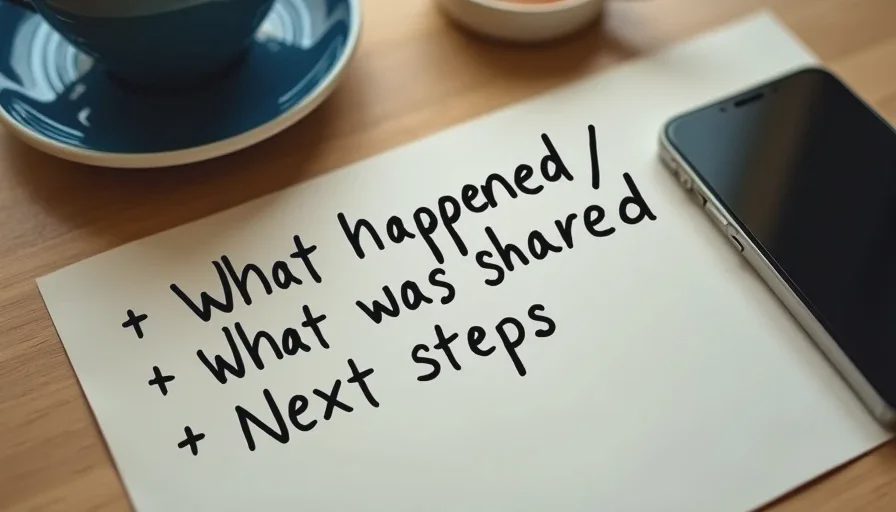
Immediate Practical Steps to Take Together
Once the facts are clear, move to action while the other person is still engaged.
Secure accounts that may have been exposed (email first, then banking and any account whose password or code was shared).
Contact financial institutions if money or card details were involved. Use numbers from the back of the card or the official website, never numbers supplied by the scammer.
Disconnect or scan the device if remote access or a download was involved.
Document the messages, numbers, and any transaction IDs for the bank or police report if needed.
Tell the other adults in the household the pattern so they are less likely to hit the same scam.
Doing these steps side-by-side reinforces that the problem is being handled as a team.
After the Immediate Crisis
A short follow-up conversation a day or two later is often more valuable than the first one. By then the panic has dropped and the person can absorb one or two durable lessons without feeling attacked.
Focus on patterns, not personal failing:
“The urgent package text is one of the most common right now. Here’s how we check those.”
“Real Microsoft or bank support doesn’t call out of the blue and ask for remote access.”
“If anything ever feels even a little off, it’s always okay to call me before responding.”
If the person is an older parent, consider whether a technical control (call-blocking apps, reduced permissions, or a simplified phone setup) would reduce future risk without removing needed independence. Introduce any such change as support, not punishment.
If the person is a teenager, resist the urge to add heavy surveillance in the emotional aftermath. Tighten specific settings if needed, but keep the emphasis on reporting early rather than on being watched.
The Longer Household Benefit
Families that handle the first scam without shame become harder to victimize overall. People report suspicious messages while there is still time to intervene. Patterns are shared quickly. The household develops a common language for urgency, remote access, and unexpected payment requests.
Families that respond with anger or ridicule often create a second problem: the next incident is hidden until the damage is larger. The scammer receives the silence they need.
A no-shame conversation is therefore not mainly about being kind. It is about keeping the information channel open so the technical defenses already in place can actually be used. Calm support in the first hour produces better facts, faster containment, and a family member who is still willing to speak up the next time something feels wrong.
That outcome is worth more than the momentary satisfaction of pointing out that the message was obviously fake. The message was designed to look non-obvious in the moment it was received. Treating the person who encountered it as a partner in fixing the problem is the more effective long-term strategy.
Make the safer choice the easier choice after a scam by removing the social cost of telling the truth. When reporting an incident does not carry punishment, the household gains the one advantage scammers cannot easily defeat: early, accurate information.
When to Replace a Laptop, Phone, Router, or Modem for Security Reasons
This is the last
→

Comments
Leave a comment
No comments yet.